
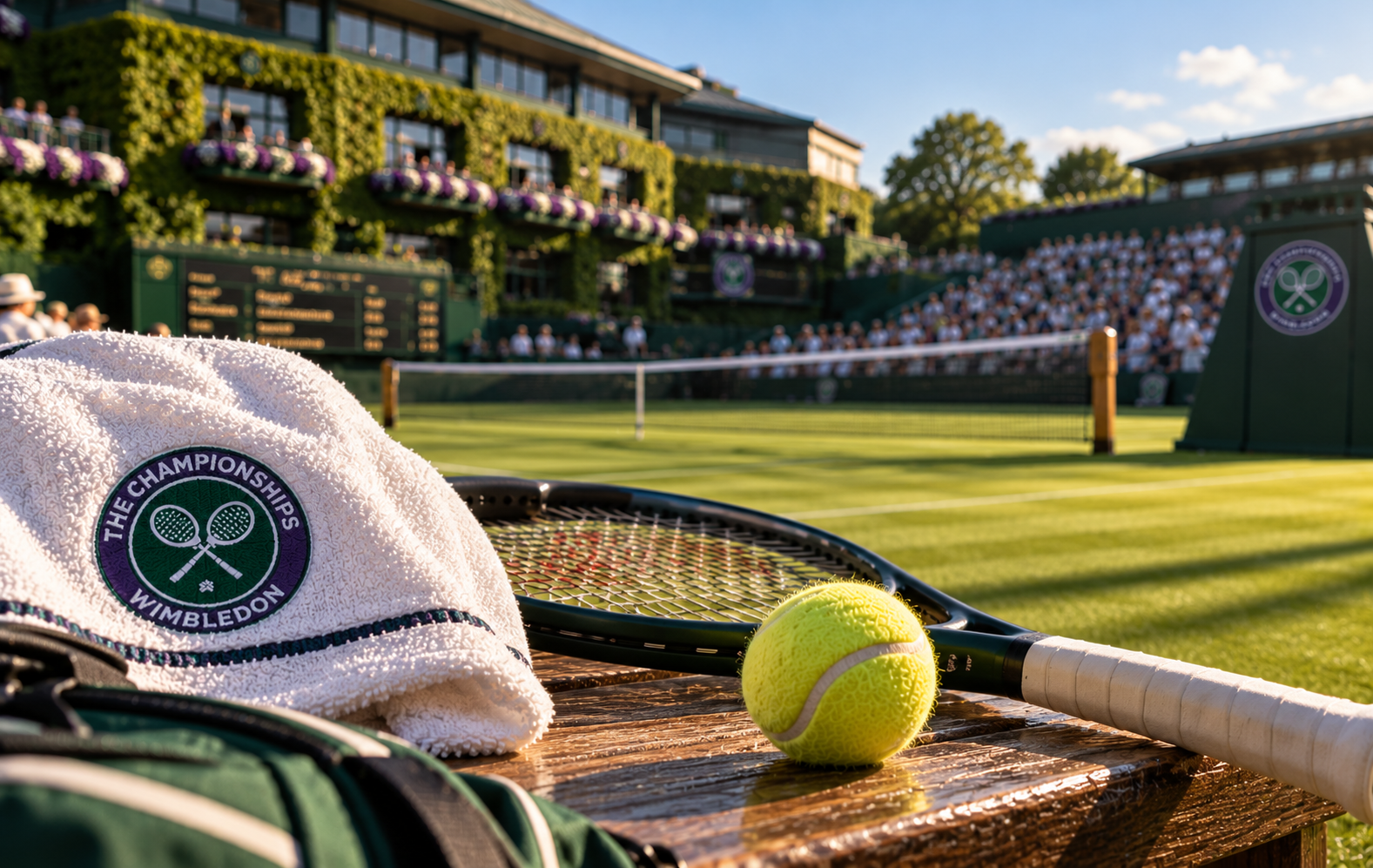
There is something slightly unusual about Wimbledon.
At most major tennis tournaments, players arrive wearing colourful outfits, music fills the stadium between matches, and the event feels unmistakably modern.
At Wimbledon, everything seems to operate according to a different set of rules.
The players wear white.
The courts are green.
The atmosphere is carefully traditional.
Strawberries and cream somehow become part of the sporting experience.
And a tennis match can feel less like an ordinary tournament and more like an event that has been taking place forever.
Which, by tennis standards, it almost has.
But why is Wimbledon so different from other tennis tournaments?
The answer goes much deeper than clothing and strawberries.
Wimbledon is the oldest of the four Grand Slam tennis tournaments, the only one still played on grass, and an event that has built its identity around an unusual combination of history, ritual and sporting excellence.
Yet it isn't simply frozen in the past.
Modern technology, changing playing styles and evolving tournament rules have transformed Wimbledon considerably.
The fascinating part is how it manages to change while still looking unmistakably like Wimbledon.
What Makes Wimbledon Unique?
Here is the short version.
Wimbledon's own historical records trace the first Championships to 1877, while its court-maintenance documentation explains the unusually detailed preparation of its grass surfaces.
Let's explore why these differences matter.
1. Wimbledon Is the Oldest Grand Slam Tennis Tournament
Wimbledon began in 1877.
The first Championships were held at the All England Croquet and Lawn Tennis Club in Wimbledon, London.
The inaugural tournament featured 22 men competing in singles.
Spencer Gore became the first champion, with approximately 200 spectators watching the final.
The women's singles competition was added in 1884, when Maud Watson became the first women's champion.
These details come directly from Wimbledon's official historical archive.
That history matters because Wimbledon wasn't created as a modern entertainment product.
It developed alongside the early history of lawn tennis itself.
The sport changed.
The equipment changed.
Professionalism arrived.
Television transformed its audience.
And the tournament continued.
Why history changes the atmosphere
When you watch Wimbledon, you're not simply watching a competition that happens to have an old name.
You're watching a tournament whose identity has been built over generations.
The grounds, ceremonies, clothing rules and presentation all refer back to that history.
This is one reason Wimbledon can feel different even before the first ball is struck.
The event is designed to remind spectators that they're watching part of a longer sporting tradition.
2. Wimbledon Is the Only Grand Slam Played on Grass
This is arguably Wimbledon's most important difference.
The four Grand Slam tournaments are played on three types of surface.
Wimbledon is the only remaining grass-court Grand Slam.
And grass isn't simply a different colour beneath the players' shoes.
It changes the tennis.
Why grass-court tennis feels different
Grass can produce lower, skidding bounces, particularly compared with clay.
Players need to adjust their footwork and balance.
The surface can be slippery, especially when conditions are damp.
And the way the ball responds depends on factors such as the condition of the grass, the underlying soil, the weather and how much a particular area of the court has worn.
Historically, grass rewarded strong serving, attacking tennis and effective net play.
Modern grass-court tennis is more varied.
Baseline players can succeed.
Long rallies are common.
And Wimbledon is no longer simply a tournament where everybody serves and rushes to the net.
But the surface still creates a distinctive tactical challenge.
MVTA Coach's Take: The surface changes the solution
A player who feels comfortable on a clay court may need to make significant adjustments on grass.
The ball may arrive at a different height.
Movement requires different timing and balance.
Some defensive positions become less comfortable.
And the value of certain attacking shots changes.
This is an important lesson even if you never play Wimbledon.
Good tennis technique must be adaptable.
The objective isn't to play exactly the same way on every surface.
It's to understand how the conditions influence your decisions.
3. The Wimbledon Grass Is Maintained With Extraordinary Precision

You might assume the Wimbledon groundskeepers simply cut the grass very carefully.
The reality is considerably more complicated.
According to Wimbledon's official grounds information, the Championships courts are sown with 100% perennial ryegrass and maintained at a playing height of 8 millimetres.
The all-ryegrass composition has been used since 2001 to improve durability, while the 8 mm cutting height has been used since 1995.
During the tournament, the courts are mown, rolled and re-lined daily, with wear, surface hardness and ball rebound monitored.
This is sports science disguised as gardening.
Why does Wimbledon use ryegrass?
The surface has to survive an extraordinary amount of high-level tennis.
Players repeatedly accelerate, brake, slide and change direction in the same areas.
The baselines receive particularly heavy wear.
Wimbledon's research with the Sports Turf Research Institute helped inform the move to a more durable grass composition.
The goal wasn't simply to create a beautiful green surface.
It was to maintain consistent playing conditions throughout the tournament.
What happens to the grass after Wimbledon?
The work doesn't stop when the champions lift their trophies.
The grounds team begins preparing for the next season almost immediately.
Courts undergo renovation, including work on the soil and grass, before the next cycle of growth and maintenance.
In a detailed 2026 Wimbledon feature, Head of Courts and Horticulture Neil Stubley and members of the grounds team explained how court renovation begins as soon as the Championships finish.
The famous grass courts are therefore not just a historical tradition.
They are a major technical operation.
And the quality of the tennis depends on it.
4. Why Do Wimbledon Players Have to Wear White?
Few tennis rules are as recognisable as Wimbledon's dress code.
At most tournaments, players can express themselves through colourful clothing.
At Wimbledon, competitors must wear almost entirely white.
Not cream.
Not off-white.
White.
The official clothing regulations allow only limited coloured trim and specify requirements for shirts, shorts, skirts, socks, shoes and accessories.
Female players are permitted to wear solid mid- or dark-coloured undershorts within the stated conditions.
Where did the all-white tradition come from?
White clothing was associated with lawn tennis from the sport's early years.
As tennis developed, white became a convention.
Wimbledon formalised a predominantly white clothing requirement in 1963 and tightened it to an almost entirely white standard in 1995.
The rule has continued to evolve.
And it has occasionally generated controversy.
For players, the regulations can limit personal expression and create practical considerations that don't exist at other tournaments.
Why does Wimbledon keep the rule?
Part of the answer is tradition.
But there is also an interesting visual effect.
The white clothing creates a strong contrast with the green grass.
It makes the tournament immediately recognisable.
A single photograph of a player dressed in white on a Wimbledon court often needs no caption.
You already know where it was taken.
That's powerful sporting identity.
Whether you love the rule or find it unnecessarily restrictive, it's difficult to imagine Wimbledon looking quite the same without it.
5. Wimbledon Has a Different Relationship With Tradition
Many sports tournaments have traditions.
Wimbledon has turned them into an essential part of its identity.
The colour scheme.
The formal presentation.
The familiar surroundings.
The historic associations with British society.
Even the language surrounding the tournament contributes to the atmosphere.
Wimbledon isn't officially marketed simply as another tennis event.
It is The Championships.
That title reflects how the tournament sees its place within the sport.
The Royal Box
Wimbledon's Centre Court includes the Royal Box, associated with members of the British royal family and invited guests.
Royal attendance has become one of the event's most recognisable traditions.
But the Royal Box also reflects Wimbledon's wider cultural position.
The tournament exists at the intersection of elite sport, British history and public ceremony.
For international visitors, that combination can feel particularly distinctive.
Is Wimbledon too traditional?
That depends on your perspective.
Some spectators love the restraint and sense of occasion.
Others prefer the energy, music and less formal atmosphere of tournaments such as the US Open.
Neither preference is wrong.
The contrast is part of what makes the four Grand Slams interesting.
They share the same sport.
They don't share the same personality.
6. Why Are Strawberries and Cream Associated With Wimbledon?
Tennis has produced some unusual sporting traditions.
But serving strawberries and cream at a major championship is certainly one of the more charming examples.
For many spectators, the combination has become inseparable from Wimbledon.
The connection reflects the tournament's English summer setting and long-established social traditions.
And it isn't merely a small ceremonial detail.
Wimbledon's historical visitor information has documented strawberries and cream being consumed in very substantial quantities during the Championships.
What makes the tradition interesting?
Strawberries and cream have very little to do with the actual mechanics of tennis.
They don't improve a forehand.
They don't help you return a serve.
And they're unlikely to solve your second-serve problems.
But they contribute to the experience.
That is one of Wimbledon's distinctive strengths.
The event has created rituals that connect spectators to the tournament beyond the score.
People remember the matches.
They also remember the setting.
The grass.
The sunshine, when it appears.
The strawberries.
And the feeling of being part of something familiar.
7. Wimbledon Has One of the Most Unusual Ticket Traditions in Sport
At many major sporting events, obtaining a ticket is primarily a matter of purchasing one online in advance.
Wimbledon has a tradition that feels considerably more old-fashioned.
The Queue.
Spectators can queue for a limited allocation of tickets available on the day of play.
The system includes Grounds passes and a limited number of Show Court tickets, subject to availability and tournament conditions.
Wimbledon's official ticket information confirms that the Queue remains part of the Championships experience.
Why is the Queue so famous?
Because it's more than a practical ticketing system.
It has become a shared experience.
Some spectators arrive extremely early.
Others prepare for long waits.
People discuss the matches they hope to see.
And the process creates a particular sense of anticipation.
Of course, queueing isn't everyone's idea of a perfect day.
But it does make Wimbledon unusual among major international sporting events.
For visitors, the Queue is one more reminder that Wimbledon has chosen to preserve certain traditions even as the wider sporting world changes.
Ticket procedures can change from year to year, so visitors should always consult the official Wimbledon website before travelling.
8. Wimbledon Has Changed More Than People Realise
Here's a surprise.
For all its traditional appearance, Wimbledon has repeatedly changed important aspects of the tournament.
One famous example is Middle Sunday.
For many years, the middle Sunday of the Championships was normally a rest day without scheduled play.
That changed in 2022, when regular Middle Sunday play became a permanent part of the schedule.
The tournament also changed its final-set tie-break system.
Since 2022, the Grand Slam events have used a harmonised format in which a match-settling tie-break is played to ten points, with a two-point margin, when the deciding set reaches 6–6.
These changes are significant.
They affect scheduling, player recovery and how matches finish.
What about electronic line calling?
Wimbledon has also modernised its officiating.
The Championships introduced live electronic line calling in 2025, replacing traditional line-judge calls with automated technology.
The official 2025 spectator handbook explained that the change followed testing and was intended to improve officiating accuracy and consistency.
For a tournament so closely associated with tradition, that is a substantial change.
And it reveals something important.
Wimbledon doesn't preserve every old practice indefinitely.
It chooses which traditions define its identity and which systems can evolve.
That balance is one of the reasons it remains relevant.
9. Wimbledon Has Produced Some of Tennis's Most Iconic Matches
A tournament's reputation isn't built by presentation alone.
Ultimately, the tennis has to justify the attention.
And Wimbledon has produced some extraordinary matches.
Roger Federer vs Rafael Nadal — 2008 final
For many fans, the 2008 men's singles final remains the defining Wimbledon match.
Federer entered as the five-time defending champion.
Nadal was determined to challenge his dominance on grass.
The final developed into a five-set contest interrupted by rain and eventually played in fading light.
Nadal won, ending Federer's run of five consecutive Wimbledon titles.
In his 2024 Dartmouth speech, Federer revisited the defeat and explained how the match exposed the importance of confidence and mental preparation, even for an established champion.
It was more than a dramatic match.
It became a defining moment in one of tennis's greatest rivalries.
Björn Borg vs John McEnroe — 1980 final
Another match that helped define Wimbledon's identity was the 1980 final between Björn Borg and John McEnroe.
The contrast was irresistible.
Borg appeared calm and controlled.
McEnroe was expressive, unpredictable and intensely competitive.
Their extraordinary fourth-set tie-break became one of tennis's most celebrated sequences.
Borg eventually won the match in five sets.
The rivalry remains a powerful example of how different personalities and playing styles can make a tennis match unforgettable.
Novak Djokovic vs Roger Federer — 2019 final
The 2019 men's singles final offered a different kind of drama.
Djokovic defeated Federer in five sets after a match lasting almost five hours.
Federer held championship points but was unable to convert them.
Djokovic eventually won the deciding-set tie-break.
The match demonstrated the extraordinary mental demands of elite tennis.
Even when a player appears to have the advantage, a Grand Slam final can turn on a handful of points.
What these matches have in common
They weren't memorable simply because they were long.
They featured contrasting playing styles, enormous pressure and moments when technical skill alone wasn't enough.
That is why Wimbledon history continues to fascinate fans.
The tournament provides the setting.
The players create the stories.
10. Winning Wimbledon Means Something Different to Many Players
Every Grand Slam is important.
Winning the Australian Open, French Open or US Open is an extraordinary achievement.
But Wimbledon carries a particular symbolic weight because of its history and its relationship with the origins of lawn tennis.
For some players, the Centre Court experience is a childhood dream.
For others, grass-court tennis presents the ultimate technical challenge.
And for British players, the tournament carries an additional national dimension.
The Federer connection
Roger Federer won Wimbledon eight times in men's singles.
His game — precise serving, fluid movement, attacking variety and comfort moving forward — became closely associated with Centre Court.
In his Dartmouth address, Federer spoke about the unique emotional significance of walking onto Centre Court and winning the Championships.
That connection is particularly meaningful for tennis fans in Switzerland.
Federer didn't simply win Wimbledon.
He became one of the defining figures of its modern history.
The Serena Williams connection
Serena Williams won seven Wimbledon singles titles.
Her success demonstrated how a dominant serve, powerful baseline game and exceptional competitive resilience could thrive on grass.
Her Wimbledon achievements also helped define a major era of women's tennis.
The Novak Djokovic connection
Novak Djokovic's Wimbledon success offers another perspective.
His game is often associated with exceptional returning, balance and baseline consistency.
Yet he developed the tactical adaptability required to win repeatedly on grass.
That is a reminder that modern Wimbledon champions don't all play the same way.
There is no single Wimbledon formula.
The surface creates challenges.
Great players find different solutions.
What Wimbledon Can Teach Recreational Tennis Players
You don't need to play on Centre Court to learn something useful from Wimbledon.
In fact, some of its most interesting lessons apply directly to ordinary club tennis.
Adapt to the surface
Different surfaces influence bounce, movement and tactical choices.
A player who understands those differences is better prepared to adjust.
Use the serve strategically
A well-placed serve can be more valuable than an unnecessarily powerful one.
Especially when it creates an easier next shot.
Learn to move forward
Even if you're primarily a baseline player, approaching the net can give you another way to finish points.
Develop variety
Slice, changes of pace, different trajectories and tactical flexibility can all become valuable tools.
Accept that conditions change
Wind, sun, court speed, opponent and match pressure all influence how tennis is played.
The best response is not frustration.
It's adaptation.
MVTA Coach's Take: Learn the principle, not just the professional shot
Watching Wimbledon can inspire players to experiment.
Perhaps you admire Federer's variety.
Maybe Serena Williams's serving.
Or Djokovic's balance and ability to redirect the ball.
These are useful sources of inspiration.
But professional techniques should be understood in context.
Your body, experience and training history are different.
A good coach can help identify which principles are relevant to your own game.
The objective isn't to turn you into a copy of a Wimbledon champion.
It's to help you become a better version of your own tennis player.
Frequently Asked Questions About Wimbledon
Why is Wimbledon so different from other Grand Slams?
Wimbledon combines the oldest Grand Slam history with grass courts, an almost entirely white clothing rule, distinctive British traditions and a particular tournament atmosphere. It is also the only Grand Slam still played on grass.
Why do Wimbledon tennis players wear white?
White clothing has been associated with lawn tennis since its early history. Wimbledon formalised a predominantly white rule in 1963 and tightened it in 1995. The modern regulations require almost entirely white clothing, with specified exceptions.
Why is Wimbledon played on grass?
Wimbledon began during the early development of lawn tennis, when grass was the sport's original playing surface. The tournament has preserved that surface while the other Grand Slams moved to clay or hard courts.
How short is the grass at Wimbledon?
The grass is maintained at a playing height of 8 mm. Wimbledon has used 100% perennial ryegrass since 2001.
Is Wimbledon the oldest tennis tournament?
Wimbledon is the oldest of the four Grand Slam tournaments, having begun in 1877.
Why are strawberries and cream served at Wimbledon?
Strawberries and cream are a long-established part of the tournament's English summer tradition and have become one of its most recognisable spectator rituals.
Does Wimbledon still have a rest day on Middle Sunday?
No. Regularly scheduled Middle Sunday play became a permanent feature in 2022.
Does Wimbledon still use line judges?
Wimbledon introduced live electronic line calling in 2025, modernising its officiating system.
Is Wimbledon more prestigious than the other Grand Slams?
Wimbledon is often regarded as especially prestigious because of its age, traditions and history. However, all four Grand Slam tournaments are major championships of the highest level, and their relative cultural significance is partly a matter of perspective.
Can ordinary tennis players learn from Wimbledon?
Absolutely. Wimbledon offers useful examples of adapting to different surfaces, using the serve strategically, improving movement, recognising attacking opportunities and developing tactical variety.
From Watching Wimbledon to Playing Tennis Yourself
There's something about Wimbledon that makes tennis feel irresistible.
The green courts.
The white clothing.
The sound of a cleanly struck ball.
The tension of a long rally.
The moment a player moves forward and finishes a point with a perfect volley.
You watch it and think:
I'd like to do that.
Maybe not on Centre Court.
Maybe not in front of thousands of spectators.
But on a tennis court of your own, with a racket in your hand and a little more confidence in your game.
That's where the interesting part begins.
At MVTA Tennis Academy in the Zurich area, Switzerland, we welcome adults, children and juniors who want to discover tennis, develop their technique or improve their match play.
You don't need to know the history of Wimbledon.
You don't need to understand every tactical detail.
And you certainly don't need to wear white.
You just need an interest in playing.
Come and Discover Your Own Tennis Game
Perhaps Wimbledon has inspired you to try tennis for the first time.
Perhaps you already play regularly but want to become more confident, improve your serve or understand tactics better.
Or perhaps your child has discovered the sport through watching the world's best players and would like to experience it firsthand.
At MVTA Tennis Academy, we believe good coaching begins with the individual player — their level, goals, strengths and the way they naturally learn.
From beginners discovering the game to experienced players looking for their next improvement, tennis offers something for everyone.
Bring your curiosity.
Bring your enthusiasm.
Bring the serve that doesn't always land where you intended.
We'll work on the rest together on court.
Explore MVTA Tennis Academy and discover how to start or continue your own tennis journey.