
Roger Federer had a rather unusual talent.
He could make one of the most physically demanding sports in the world look like something you might do on a pleasant Sunday afternoon.
While his opponents sprinted, stretched, grunted and occasionally looked as though they were fighting for survival, Federer appeared to be having a different experience altogether.
He moved quietly.
He arrived early.
He struck the ball with a seemingly effortless swing.
And before you had quite understood what happened, the point was over.
It was beautiful to watch.
It was also slightly misleading.
Because the secret behind Roger Federer's effortless tennis was not that he worked less than other players.
In many ways, it was that he had learned to make an extraordinary amount of work almost invisible.
In his 2024 commencement speech at Dartmouth College, Federer addressed this reputation directly. His verdict was simple:
“Effortless” is a myth.
So why did his tennis look so easy?
The answer involves footwork, timing, anticipation, technique, tactical intelligence and something that doesn't always appear in the highlight videos.
Years of practice.
The Secret Behind Federer's Effortless Tennis
There wasn't one secret.
Federer's style came from several abilities working together.
These are not seven independent tricks.
They reinforce one another.
Good anticipation makes movement easier. Good movement improves contact. Better contact makes the swing more efficient. An effective serve creates a more predictable next shot.
The result can look like magic.
But much of it is simply excellent tennis performed in the right sequence.
1. Federer Was Often in Position Before the Ball Arrived
The art of looking like you're barely running
Watch Federer during a baseline rally.
Not his racket.
His feet.
He constantly makes small adjustments to his position. He changes direction, finds his balance and creates space between his body and the incoming ball.
Then, when he strikes, everything looks organised.
That is one of the reasons his movement appeared so smooth.
The viewer usually notices the final step and the beautiful shot.
The preparation happened earlier.
ATP's retrospective on Federer's career specifically identifies his fluid movement as the foundation of his shotmaking. The same analysis describes how he could move forward into the court and take the ball early without appearing hurried.
This distinction matters.
Federer wasn't simply fast.
He was exceptionally good at using movement to arrive in a position where he could hit the shot he wanted.
Anticipation versus reaction
Imagine two players facing the same crosscourt forehand.
Player A recognises the direction early, turns their shoulders and starts moving.
Player B waits until the ball is clearly travelling towards them.
Both may reach the ball.
But Player A has more time to organise the shot.
Player B may have to improvise.
That difference can be enormous.
Rod Laver, an 11-time major champion and one of the most authoritative observers of elite tennis, highlighted Federer's anticipation and timing among the defining qualities of his game.
Of course, anticipation isn't mind-reading.
It's recognising information: an opponent's court position, preparation, contact point and likely tactical options.
The better you read the game, the less hurried your movement needs to look.
MVTA Coach's Take: Watch the feet, not the winner
One of the most useful ways to study Federer is to ignore the spectacular final shot.
Instead, watch the three seconds before it.
Where was he standing?
When did he begin preparing?
How many adjustment steps did he take?
Was he balanced when he made contact?
For recreational players, improving these details may produce more reliable results than trying to copy his racket swing.
Try this: During your next practice session, focus on recovering your balance after every groundstroke and preparing before the incoming ball crosses the net.
It won't immediately make you look like Federer.
But it is a much better starting point than attempting his most spectacular forehand.
2. His Timing Made Power Look Easy
The difference between hitting hard and hitting cleanly
There is a common misconception about powerful tennis.
If a player hits the ball extremely hard, they must be swinging with extraordinary visible effort.
Sometimes that's true.
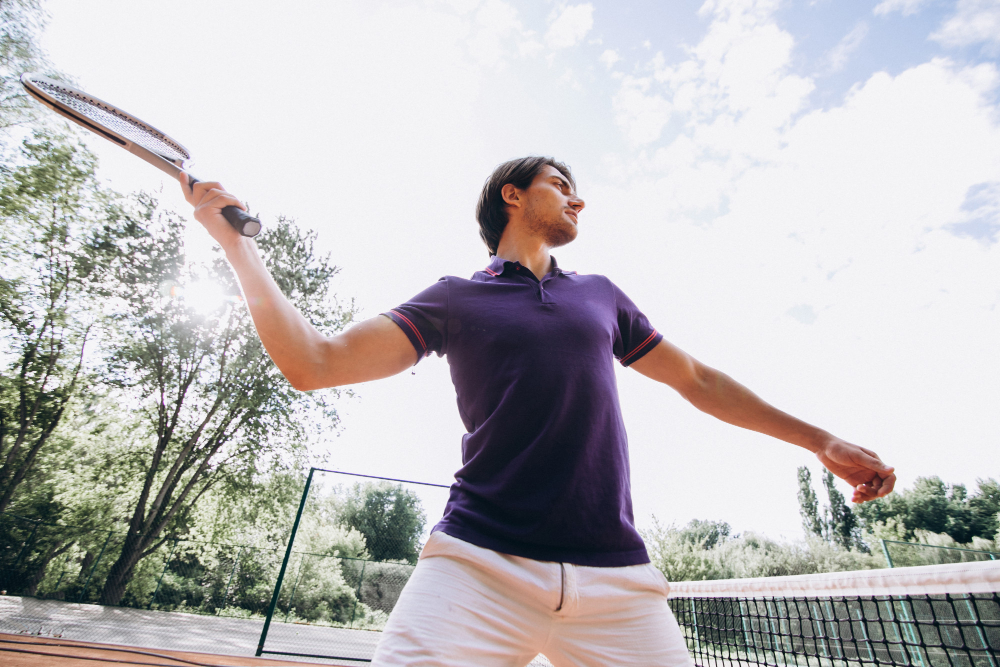
But a clean, well-timed strike can generate impressive pace without a swing that looks violent.
Federer was particularly good at making contact while his body, racket and footwork were working together.
His forehand could accelerate suddenly, even from situations that initially looked neutral.
ATP's technical portrait of Federer describes his ability to take the ball on the rise and turn an ordinary rally into an attacking opportunity.
Taking the ball on the rise means contacting it after the bounce but before it reaches its highest point.
Why does that matter?
Because the opponent gets less time to recover.
The shot doesn't necessarily need to be faster.
It arrives sooner.
And in tennis, taking away time can be just as damaging as adding speed.
Why timing is difficult to copy
Professional timing is built through enormous repetition and the ability to adjust to different balls.
The height changes.
The spin changes.
The speed changes.
The distance changes.
A small mistake in spacing can turn a beautiful-looking forehand into an uncomfortable contact.
That's why simply copying Federer's swing shape is unlikely to reproduce Federer's results.
You also need the preparation, positioning and contact point that made the swing possible.
MVTA Coach's Take: Stop trying to hit every ball harder
For many adult players, the quickest improvement comes from cleaner contact rather than additional effort.
Try a simple rally drill.
Hit at a comfortable pace and concentrate on meeting the ball at a consistent distance from your body.
Only increase the speed when you can maintain your balance and contact quality.
First, make the shot repeatable. Then make it more aggressive.
That is a much more useful lesson from Federer than attempting a spectacular winner on every third ball.
3. Federer's Forehand Was Powerful Because It Was So Versatile
For much of his career, Federer's forehand was his most recognisable attacking weapon.
It could produce heavy topspin.
It could flatten out a short ball.
It could find a sharp crosscourt angle.
And it could suddenly change direction down the line.
But perhaps the most important feature was how quickly he could turn a neutral ball into an offensive one.
ATP's career analysis describes his forehand as a devastating shot that could generate sudden acceleration and spin.
The swing looked fluid because Federer had spent years developing a movement pattern that worked at extraordinary speed.
That doesn't mean it was simple.
In fact, its apparent simplicity was part of the illusion.
The Federer forehand lesson for club players
You don't need Federer's exact grip, stance or swing.
What you can learn is how to use a forehand with a clear tactical purpose.
A deep crosscourt forehand can push an opponent back.
A shorter angle can move them off the court.
An inside-out forehand can attack a weaker backhand.
And a well-chosen down-the-line shot can change the direction of the rally.
The goal isn't to produce one beautiful forehand.
It's to develop a forehand that helps you construct points.
4. His Serve Was Smarter Than It Looked
Federer wasn't the tallest player on tour.
Nor did his game depend on serving at the highest possible speed.
Yet his serve was one of the foundations of his success.
Why?
Because a great serve isn't measured by speed alone.
Placement matters.
Spin matters.
Disguise matters.
And the next shot matters.
Federer could vary his serve sufficiently to keep returners uncertain. He could move the ball wide, attack the body or find the centre line, then use the resulting return to take control.
ATP's retrospective emphasises the precision of his serve rather than simply its raw power.
The serve is the beginning of a pattern
Think of a serve out wide.
The returner moves away from the centre of the court.
A return comes back.
The server now has an opportunity to hit into the space that has opened.
That's a serve-plus-one pattern: using the serve to prepare the first groundstroke.
Federer was exceptional at making this sequence appear natural.
But it was tactical construction, not luck.
MVTA Coach's Take: Practise the serve and the next ball
Many recreational players practise serves by hitting an entire basket and then collecting the balls.
That develops certain skills.
But it doesn't teach you what happens after the return.
A more match-relevant exercise is to serve to a specific target and then play the first groundstroke with a clear intention.
For example:
Serve wide → recover → attack the open court.
The objective is not simply to serve harder.
It is to start the point with a plan.
5. His One-Handed Backhand Gave Him More Than One Answer
The Federer backhand is one of the most recognisable strokes in tennis.
It is also one of the most misunderstood.
People remember the spectacular topspin winners.
But his backhand was much more than that.
He could hit through the ball.
He could roll it with topspin.
He could use a low, skidding slice.
He could change pace and trajectory.
This variety was a major part of his all-court identity.
ATP's analysis highlights the different spins, angles and trajectories available from his backhand side.
The Nadal problem
Of course, the one-handed backhand also had vulnerabilities.
Rafael Nadal famously used his heavy, high-bouncing left-handed forehand to challenge Federer on the backhand side.
The tactic could force Federer to make contact at an uncomfortable height, particularly on clay.
ATP identifies this matchup as an important tactical challenge in their rivalry.
That's an important reminder.
Even the most elegant technique has trade-offs.
There is no universally perfect stroke.
What should recreational players copy?
Not necessarily the one-handed backhand.
If you already have a reliable two-handed backhand, there is no reason to abandon it simply because Federer's looks beautiful.
A more practical lesson is the value of variation.
Can you defend with your backhand?
Can you keep the ball deep?
Can you change pace?
Can you use a slice when the situation calls for it?
These are more useful questions than whether your follow-through resembles Federer's.
6. Federer Made Difficult Decisions Look Automatic
Tennis is a sport of constant decisions.
Should you attack?
Defend?
Change direction?
Move forward?
Hit with more spin?
Take the ball early?
Most recreational players recognise these choices.
The problem is making them quickly enough.
Federer had an enormous repertoire, but his game was not simply a collection of beautiful shots.
He used those shots to solve tactical problems.
Sometimes he attacked from the baseline.
Sometimes he sliced to change the rhythm.
Sometimes he moved forward to finish.
And sometimes he defended until a better opportunity appeared.
This flexibility is one reason Federer became such a compelling example of all-court tennis.
Why variety can make tennis look easier
Imagine facing an opponent who can only win points in one way.
Once you recognise the pattern, you can begin organising your defence around it.
Now imagine an opponent who can win from the baseline, approach the net, change spin or take the ball early.
The tactical problem becomes much more complicated.
Federer frequently made opponents solve several problems at once.
That doesn't mean he made the right decision on every point.
It means he possessed enough reliable options to adjust.
MVTA Coach's Take: Build a Plan A before collecting Plan B, C and D
Variety is valuable.
But random variety is not strategy.
For developing players, the priority should be a dependable way to construct points.
Perhaps that means a strong crosscourt forehand.
Perhaps it means a reliable serve followed by an attacking first ball.
Once you have a stable pattern, additional options become more useful.
A good playing style isn't about owning every shot. It's about knowing when to use the shots you have.
If you're interested in understanding how different players build points, our guide to tennis playing styles explores six common approaches, from aggressive baseline tennis to serve-and-volley.
7. The Calm Was Learned, Not Inherited
This may be the most important part of the Federer story.
His elegance wasn't just physical.
It was emotional.
He rarely appeared to panic, even when a match became tense.
But young Federer was not always the composed player people remember.
In his Dartmouth speech, he spoke openly about the frustration, racket throwing and emotional outbursts of his earlier years.
He also explained how criticism of his mental discipline helped him recognise that talent alone would not be enough.
That is a very different story from the idea of a naturally perfect champion.
He had to learn discipline.
He had to improve his physical preparation.
And he had to become more resilient.
The hidden work behind the beautiful tennis
Federer explained that much of his hardest work happened away from the public eye.
Spectators saw the tournament.
They didn't see every training block that came before it.
They saw a relaxed warm-up.
They didn't see all the preparation that made the match possible.
The calm appearance was the finished product.
Not the absence of effort.
A remarkable lesson about losing points
During the same speech, Federer shared a statistic from his career.
Across 1,526 singles matches, he won almost 80% of those matches but only about 54% of the individual points.
Think about that.
One of the greatest players in tennis history still lost a huge number of points.
What separated him from less successful players wasn't perfection.
It was the ability to keep competing after mistakes.
For a recreational player, that may be the most useful Federer lesson of all.
You don't need to win every rally.
You need to remain ready for the next one.
8. Did Federer Really Make Tennis Look Easier Than Djokovic or Nadal?
Federer, Rafael Nadal and Novak Djokovic developed very different visual identities.
Nadal's tennis often looked intensely physical, with explosive movement and heavy topspin.
Djokovic became famous for extraordinary flexibility, defensive balance and the ability to redirect the ball from difficult positions.
Federer's game often looked quieter and more economical.
But appearance is not a reliable measure of effort.
All three players built their success on exceptional physical conditioning, movement, technical skill and tactical intelligence.
ATP's retrospective makes this contrast particularly vivid, describing Federer's quiet movement alongside the more visibly strenuous styles of his great rivals.
It would be a mistake to conclude that Federer worked less.
He simply expressed elite tennis differently.
And that is part of what made their rivalries so compelling.
They were not three copies of the same champion.
They were three different answers to the same question:
How do you win a tennis match against the best players in the world?
9. What Can Ordinary Tennis Players Learn From Federer?
You probably won't develop Federer's forehand.
You may never possess his anticipation, his serve or his range of shots.
That's fine.
You don't need to copy the finished player to learn from the principles behind his game.
Here are five lessons worth taking onto your own court.
Prepare earlier
Good preparation gives you more time and more options.
Turn your shoulders, move your feet and organise your position before the ball arrives.
Prioritise clean contact
Power without control has limited value.
Find a repeatable contact point before increasing speed.
Make the serve purposeful
Don't think only about winning a point directly with the serve.
Think about the return you're trying to create.
Learn to recognise attacking opportunities
Not every ball should be attacked.
Not every ball should be defended.
The ability to distinguish between them is a major part of tactical development.
Move on after mistakes
Even Federer lost nearly half the points he played.
A double fault or missed forehand doesn't have to decide what happens next.
The next point deserves your full attention.
10. Can You Learn to Play Tennis More Effortlessly?
Yes — but not by trying to look effortless.
That is the paradox.
If you concentrate on copying Federer's appearance, you may overlook the things that made his movement effective.
Better technique can reduce unnecessary effort.
Better footwork can make difficult balls easier to reach.
Better anticipation can give you more time.
Better tactical choices can prevent you from having to hit spectacular shots from terrible positions.
And consistent practice can make these skills more automatic.
The aim isn't to eliminate effort.
It's to use effort more efficiently.
That is a realistic goal for beginners, adult recreational players and ambitious juniors alike.
Frequently Asked Questions About Roger Federer's Playing Style
Why did Roger Federer make tennis look so effortless?
Federer's smooth appearance came from a combination of precise footwork, early preparation, timing, efficient shotmaking, tactical variety and emotional control. Federer himself stressed that this apparent ease was the result of extensive training rather than a lack of effort.
What made Roger Federer's footwork so special?
His movement helped him arrive balanced and well positioned, allowing him to take balls early and create attacking opportunities. His ability to prepare efficiently was a central part of his shotmaking.
Why was Roger Federer's forehand so good?
Federer's forehand combined timing, acceleration, spin, placement and the ability to take time away from opponents. Its effectiveness was closely connected to his movement and early ball contact.
Was Roger Federer naturally talented or did he train harder?
Both natural ability and training contributed to his success. Federer explicitly rejected the idea that his tennis came easily, describing years of hard work, physical preparation and emotional development in his Dartmouth speech.
What type of tennis player was Roger Federer?
Federer is commonly described as an all-court player, although his style evolved throughout his career. His game combined baseline attack, slice, transition play, serving variety and effective net play.
Can beginners learn Federer's technique?
Beginners can learn useful principles from Federer's game, especially early preparation, balance, timing and point construction. Copying his exact professional strokes, however, is not necessary and may not suit an individual player's physical characteristics or technical development.
Why did Federer use a one-handed backhand?
The one-handed backhand was part of Federer's individual technique and offered considerable versatility, including topspin, slice and changes of pace. It also presented challenges against certain high-bouncing balls, particularly in his matches against Nadal.
From Watching Federer to Improving Your Own Tennis
There's something inspiring about watching Roger Federer.
His game makes you want to pick up a racket.
To hit a clean forehand.
To move a little more smoothly.
To play a point that feels, just for a moment, completely under control.
But the most valuable lesson from Federer isn't that tennis should look easy.
It's that good tennis is built.
Through practice.
Through intelligent coaching.
Through repetition, mistakes, adjustments and gradual improvement.
At MVTA Tennis Academy in the Zurich area, Switzerland, we welcome adults, beginners, children and juniors who want to discover tennis or develop their game further.
You don't need a Federer forehand to start.
You don't need a perfect serve.
And you certainly don't need to look effortless.
Whether you're learning your first groundstrokes, trying to improve your movement or looking for more confidence in competitive matches, the goal is to build a game that works for you.
Come and Play Tennis With Us
If watching Federer makes you want to play, we'd love to see you on court.
At MVTA Tennis Academy, we help players work on technique, movement, tactical understanding and match confidence at a level appropriate to their experience.
Bring your enthusiasm.
Bring the forehand that occasionally has ideas of its own.
And bring the ambition to improve — whatever that means for you.
Explore our tennis academy and training programmes and take the next step in your own tennis journey.