
Buying a tennis racket today is both easy and surprisingly difficult.
Easy because there are hundreds of models available. Difficult because many players focus on the brand, the price tag, or a friend's recommendation and end up with a racket that simply doesn't suit their game.
Sound familiar?
Someone buys the same racket used by a famous professional, steps onto the court and, after a few training sessions, realises something isn't right. Their arm feels tired, shots are inconsistent, and the game isn't nearly as enjoyable as expected.
The interesting part? The problem is often not the technique at all. Quite often, it comes down to the racket itself.
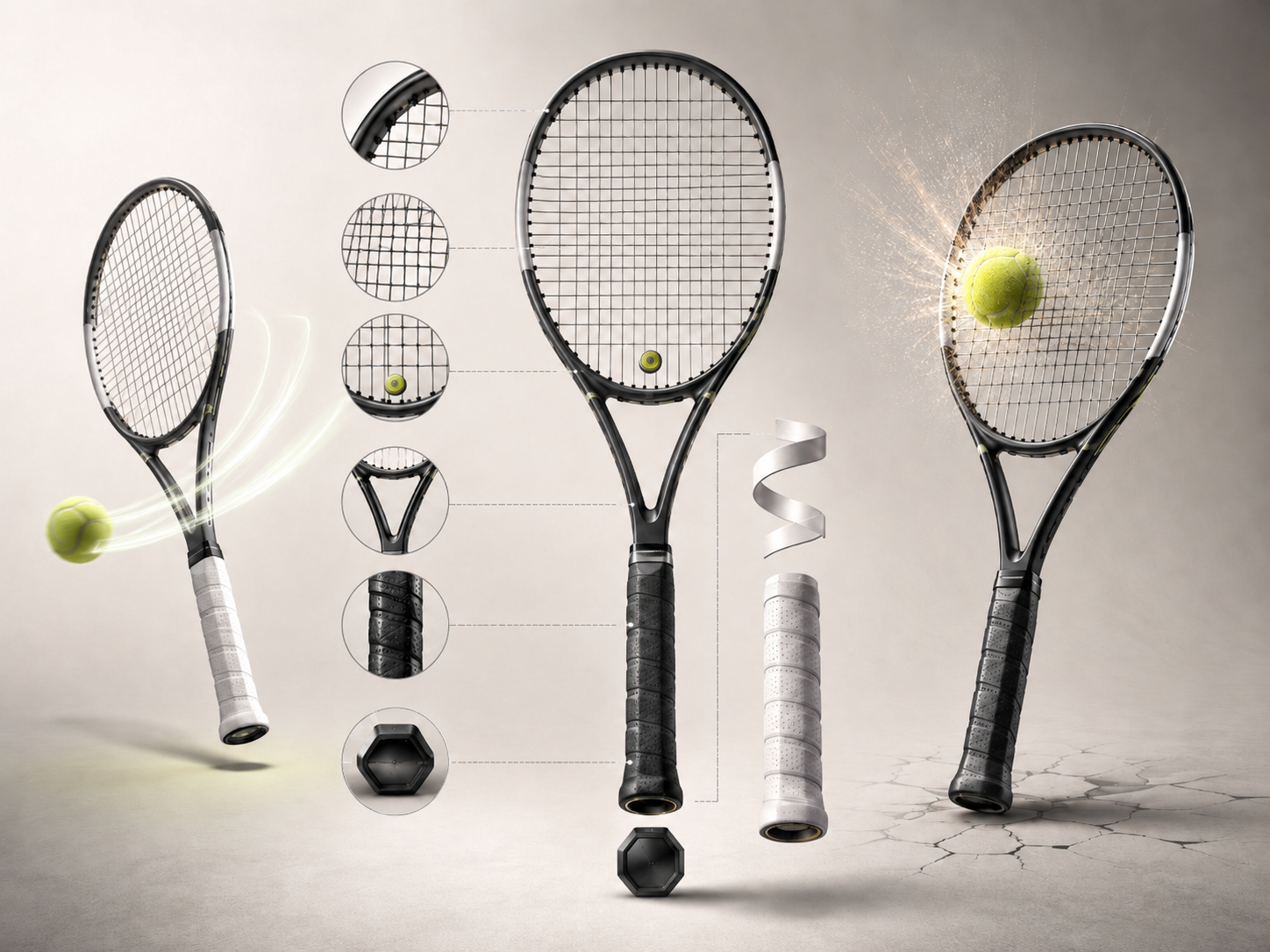
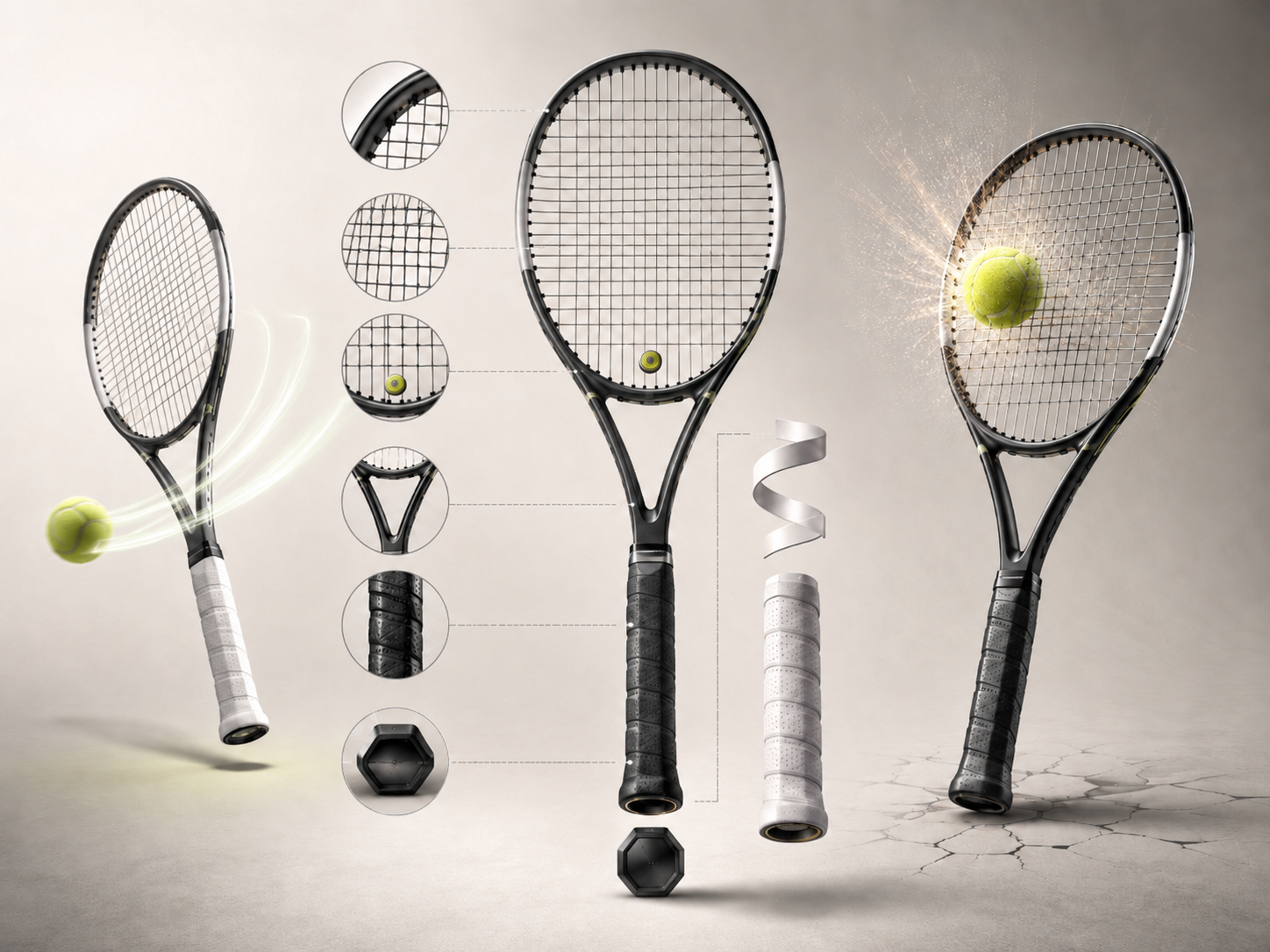
What Is a Tennis Racket Made Of?
At first glance, a tennis racket looks fairly simple.
There's a head, a string bed and a handle.
However, every component influences how the racket performs on court.
The main parts include:
- the frame;
- the string bed;
- the throat;
- the handle;
- the butt cap;
- the replacement grip;
- the overgrip;
- a vibration dampener (optional).
By the way, many beginners believe that a vibration dampener protects the arm from injury. That's actually a common myth. Its primary purpose is to alter the sound and feel of ball impact. While some players perceive a reduction in vibration, there is no strong evidence that a vibration dampener alone prevents tennis-related injuries.
Weight: The First Specification to Consider
Ask a group of tennis coaches which racket specification matters most, and many will immediately mention weight.
Why?
Because it's the characteristic every player notices straight away.
A lighter racket accelerates more easily through the swing. A heavier racket provides greater stability and absorbs incoming pace more effectively.
For most adult recreational players, the following weight ranges work well:
Competitive players often use rackets weighing 305–330 g unstrung, although personal preference varies considerably.
At first, choosing the lightest possible racket may seem logical.
However, there's a catch.
If a racket is too light, it can struggle against heavy shots. Instead of feeling solid at contact, it may twist slightly in the hand when facing a fast ball.
That's why finding the right balance between comfort and stability is so important.
Balance: The Specification That Changes Everything
This is where things get interesting.
Two rackets can weigh exactly the same — 300 grams, for example — yet feel completely different on court.
Why?
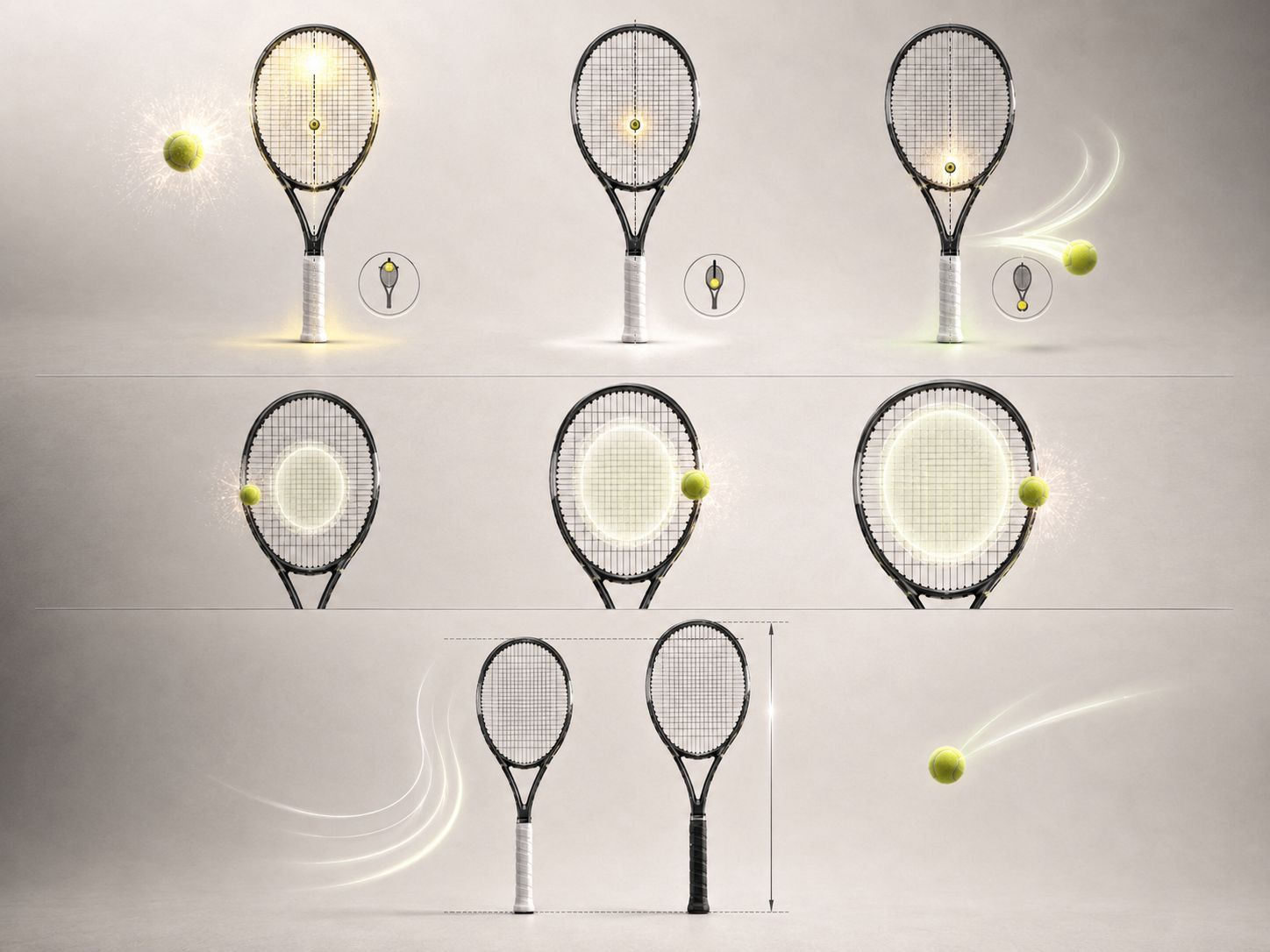
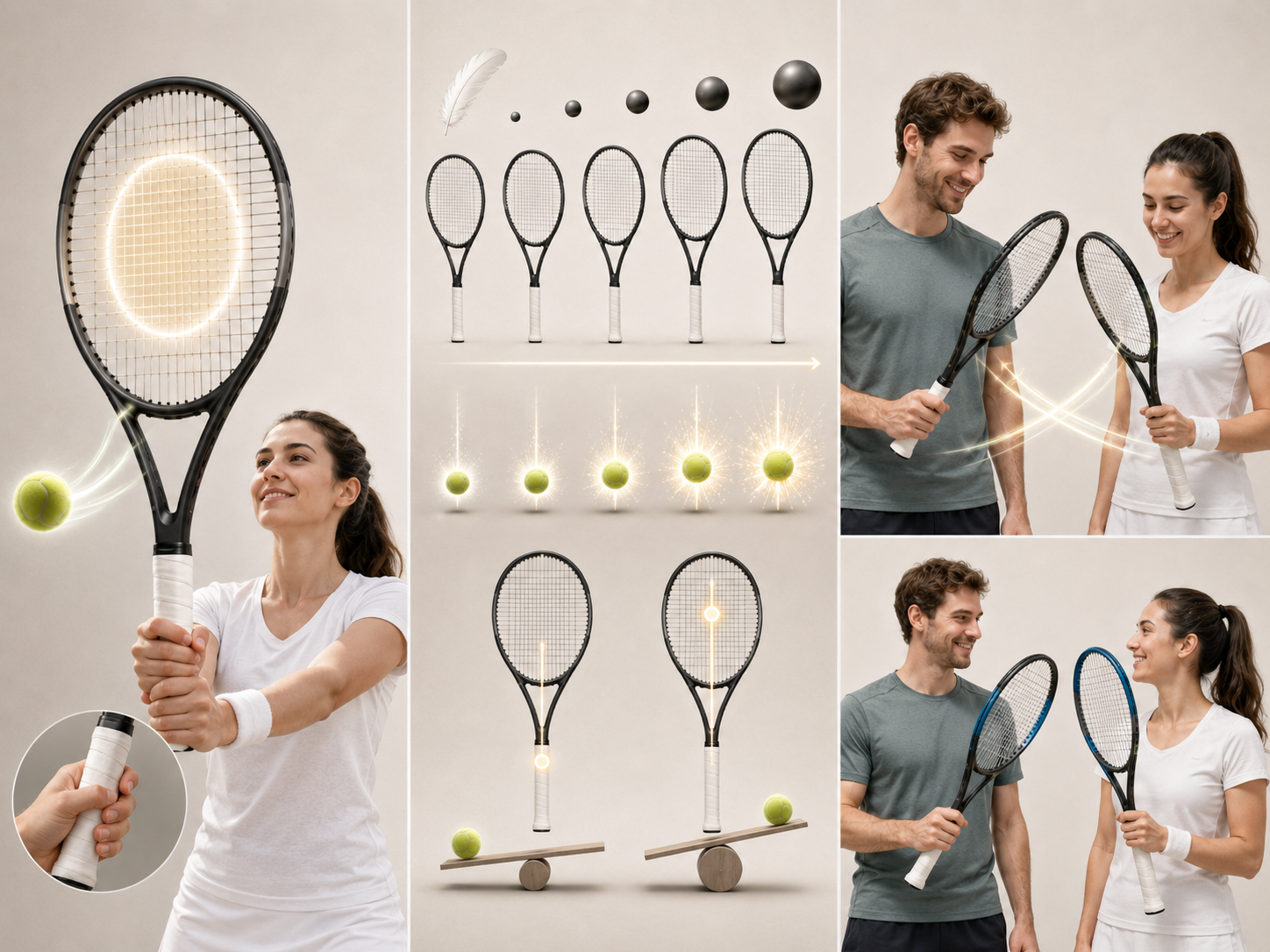
Because weight is only part of the story. What really matters is how that weight is distributed throughout the racket.
Head-Heavy Balance
A head-heavy racket typically provides:
- more power;
- a heavier ball;
- extra assistance from the baseline.
The trade-off is that it can place greater strain on the arm, especially during longer sessions.
Head-Light Balance
A head-light racket offers:
- improved manoeuvrability;
- quicker reactions at the net;
- enhanced control.
Most modern all-round rackets sit somewhere in the middle, combining stability with ease of handling.
Head Size: Is Bigger Really Easier?
In most cases, yes.
Head size is measured in square inches and has a significant impact on how forgiving a racket feels.
The most common options are:
- 95–98 sq in – greater control, but less forgiveness on off-centre shots;
- 100 sq in – the classic all-round choice;
102–110 sq in – a larger sweet spot and additional forgiveness on off-centre shots.
If you play a few times a week for fitness, enjoyment or social matches, a head size around 100 square inches is often the most comfortable and versatile option.
Racket Length: Does It Matter?
Yes, although not as much as many players think.
The standard length of an adult tennis racket is 27 inches (68.6 cm), and for most players, this remains the best option.
Longer rackets, typically measuring 27.25–27.5 inches, can provide additional leverage, helping to generate more power on serves and groundstrokes. They may also slightly increase reach, which can be useful when defending wide balls.
However, there is always a trade-off.
A longer racket can feel less manoeuvrable, particularly during quick exchanges at the net, and usually requires more refined technique to control effectively.
For beginners and recreational players, a standard 27-inch racket is generally the safest and most versatile choice. Extended-length models are often better suited to experienced players who understand exactly what they want from their equipment.
Grip Size: An Underrated Factor
To be honest, this is where many players make mistakes.
They buy an excellent racket, only to experience discomfort because the grip size isn't right.
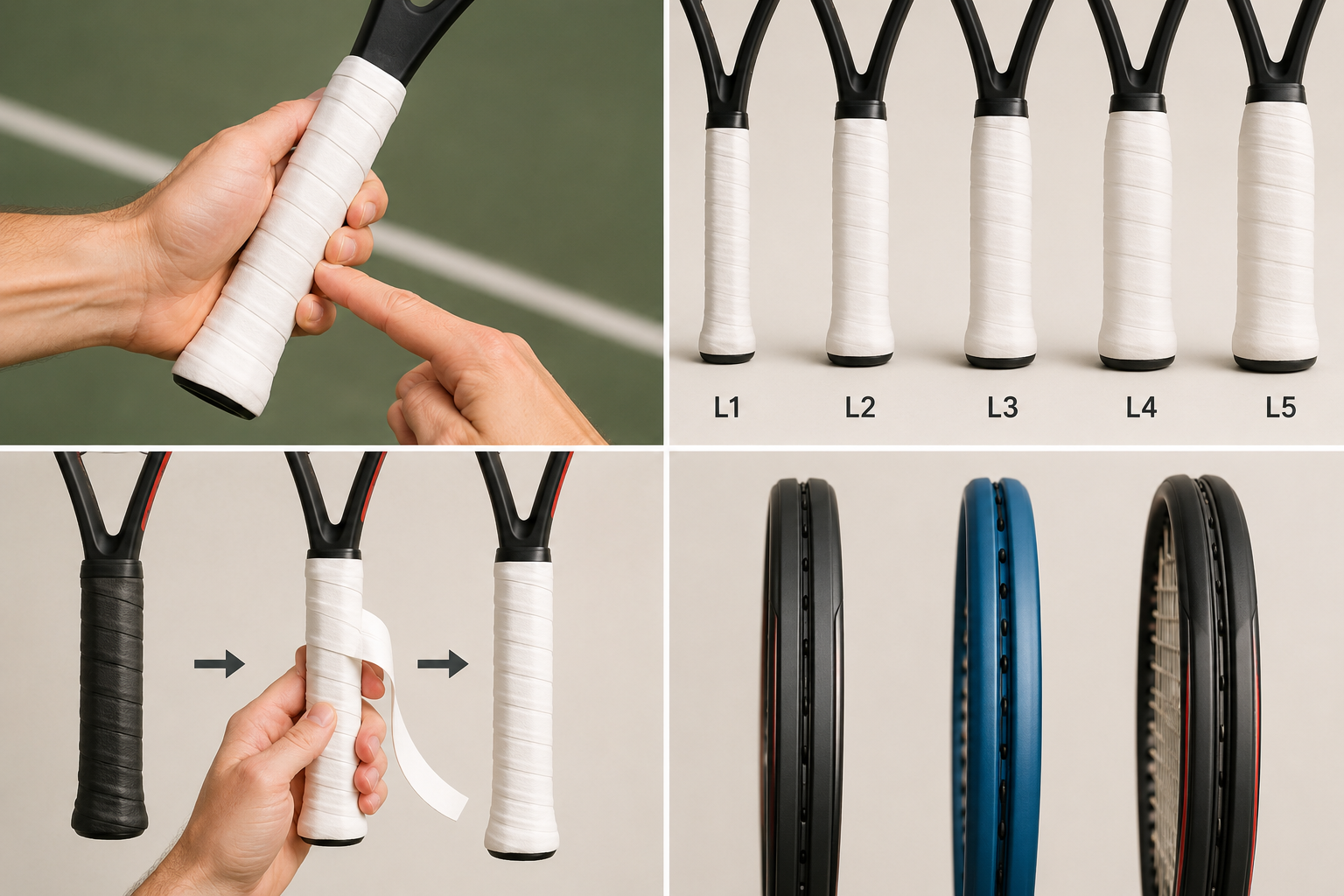
Tennis grip sizes are usually labelled as:
- L1
- L2
- L3
- L4
- L5
As a general guideline, L2 suits many women, while L3 is common among men. However, grip size should never be chosen based solely on gender.
The shape and size of your hand matter far more.
A simple test is to hold the racket in a continental grip. There should be enough space between your fingertips and the base of your thumb to fit the index finger of your other hand.
If the grip is too large, control often suffers.
If it's too small, you'll naturally squeeze the handle more tightly, which can lead to unnecessary tension in the hand, wrist and forearm.
Replacement Grips and Overgrips
Every tennis racket comes with a factory-installed replacement grip.
Many players then add an overgrip on top of it.
Why?
There are several good reasons:
- improved sweat absorption;
- a more secure grip;
- the ability to slightly increase the handle size.
Overgrips are considered a consumable item. Players who train regularly often replace them every few weeks to maintain comfort and control.
Beam Width: A Small Detail That Matters
The beam is the thickness of the racket frame.
Generally speaking, a wider beam produces more power, while a thinner beam provides better feel and feedback from the ball.
For beginners and recreational players, rackets with a medium or slightly wider beam are often the most forgiving. They help generate depth and pace without requiring excessive effort.
Customising a Racket with Weight Tape
Not every adjustment requires a new racket.
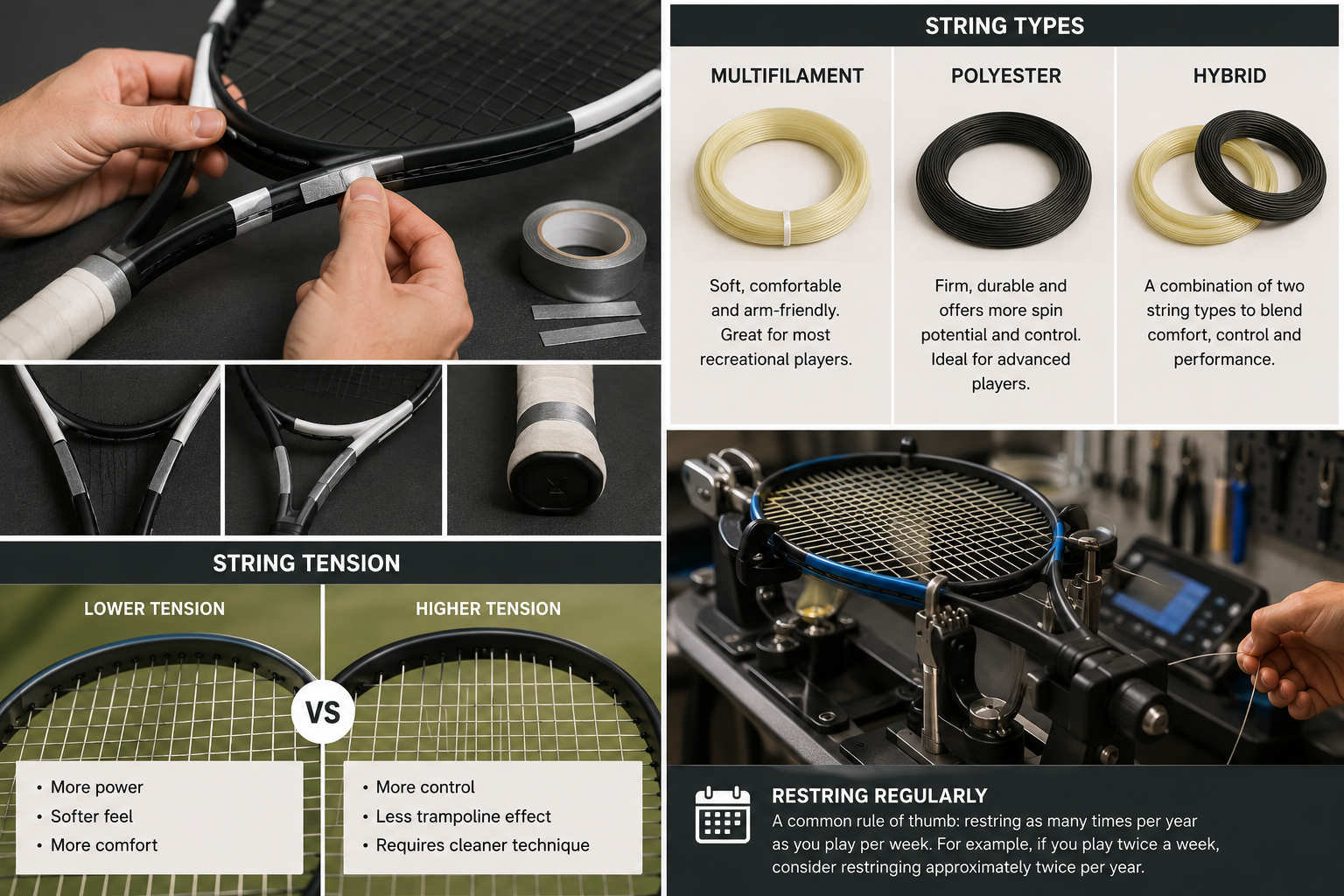
Many players fine-tune their equipment using weighted tape, usually applied to the frame or underneath the grip.
Adding weight to the head can increase power and stability. Adding weight to the handle can improve balance and overall feel. Tape placed on the sides of the frame can also make the racket more stable on off-centre shots.
That said, beginners are usually better off avoiding these modifications at first. It's important to become familiar with the racket's natural characteristics before making any adjustments.
Strings: Half of a Racket's Personality
Here's something that surprises many players.
The same racket can feel completely different after a restring.
In many cases, strings influence performance just as much as the frame itself.
The most common string types are:
Multifilament Strings
Soft, comfortable and arm-friendly.
They are an excellent option for most recreational players and anyone looking for greater comfort.
Polyester Strings
Firmer and more durable.
They provide enhanced spin potential and control, which is why they are often preferred by more experienced players.
Hybrid Set-Ups
A combination of two different string types.
Hybrid stringing allows players to blend the advantages of both materials and create a more personalised feel on court.
String Tension: Tighter Isn't Always Better
There's a common misconception in tennis that tighter strings automatically improve performance.
In reality, it's not that simple.
Lower string tension generally:
- provides more power;
- creates a softer, more comfortable feel.
Higher string tension typically:
- increases control;
- requires better technique and cleaner ball striking.
For most recreational players, a tension range of approximately 22–25 kg (48–55 lbs) provides a good balance between comfort, power and control. A common rule of thumb suggests restringing your racket as many times per year as you play each week. For example, if you play twice a week, consider restringing approximately twice per year. However, frequent players may benefit from more regular restringing. Regular restringing helps maintain consistent performance and feel on court.
How to Choose a Tennis Racket as a Beginner?
One of the biggest surprises for new players is that a beginner usually doesn't need a "professional" racket.
That may sound counterintuitive, but it's true.
During the first months of learning, comfort, forgiveness and ease of use are far more important than ultimate control.
A beginner-friendly racket should help you enjoy the game rather than punish every mistake.
At this stage, you're still developing timing, footwork, grip changes and ball contact. A racket with a small head size, a heavy frame and demanding specifications can make learning unnecessarily difficult.
For most adult beginners, the following characteristics work particularly well:
- Weight: 260–285 g unstrung;
- Head size: 100–110 sq in;
- Length: standard 27 inches;
- Balance: neutral or slightly head-heavy;
- Grip size: typically L2–L3;
- Strings: soft and comfortable rather than overly stiff.
If you're physically strong or already have experience in other sports, you may feel comfortable with a racket closer to the 285–300 g range.
On the other hand, if your wrist, elbow or shoulder tends to tire quickly, a lighter model is often the smarter starting point.
Perhaps the most important piece of advice is this:
Don't buy a racket simply because a professional player uses it.
Professional athletes have different techniques, generate much higher racket-head speeds and place very different demands on their equipment.
As a beginner, you need a racket that encourages you to stay on court for another set — not one that leaves your arm aching after a single training session.
Finding the Right Racket Weight for Your Game
Racket weight influences almost everything: power, control, comfort and even how quickly your arm becomes fatigued during a match.
A lighter racket is easier to manoeuvre. It's simpler to accelerate through the ball, easier to lift on serves and more responsive during fast exchanges at the net.
The downside?
Against heavier shots, a very light racket can sometimes feel unstable.
A heavier racket offers greater stability at impact. It absorbs pace more effectively and tends to produce a heavier ball. However, that added stability comes with increased demands on the wrist, forearm and shoulder.
As a general guide:
One important thing to remember is that the number on the specification sheet doesn't always match how a racket feels in your hand.
For example, a 290 g racket with a head-heavy balance may feel heavier during play than a 300 g racket with a head-light balance.
That's why it's always worth holding a racket before making a decision. Take a few practice swings. If it already feels uncomfortable after a minute, that's usually telling you something.
Men's and Women's Tennis Rackets: Marketing or Reality?
The answer is a bit of both.
Some rackets are designed with average physical characteristics in mind and are marketed specifically towards men or women.
However, there is no strict division in modern tennis equipment.
Many women play with heavier rackets traditionally marketed towards men, while many men prefer lighter and more manoeuvrable frames.
Ultimately, the most important factor isn't the label on the racket.
It's how the racket feels in your hand and how it performs on court.
Do Recreational Players Need a Professional Racket?
In most cases, no.
Professional rackets demand excellent technique and consistent ball striking. They are generally less forgiving when contact isn't perfect.
Think of it like a high-performance sports car.
An experienced driver can take full advantage of its capabilities. A beginner may find it difficult to control and enjoy.
The same principle applies to tennis rackets.
For most club and recreational players, a more forgiving frame will provide a better overall experience and support faster improvement.
What Are Modern Tennis Rackets Made Of?
Tennis rackets have come a long way over the years.
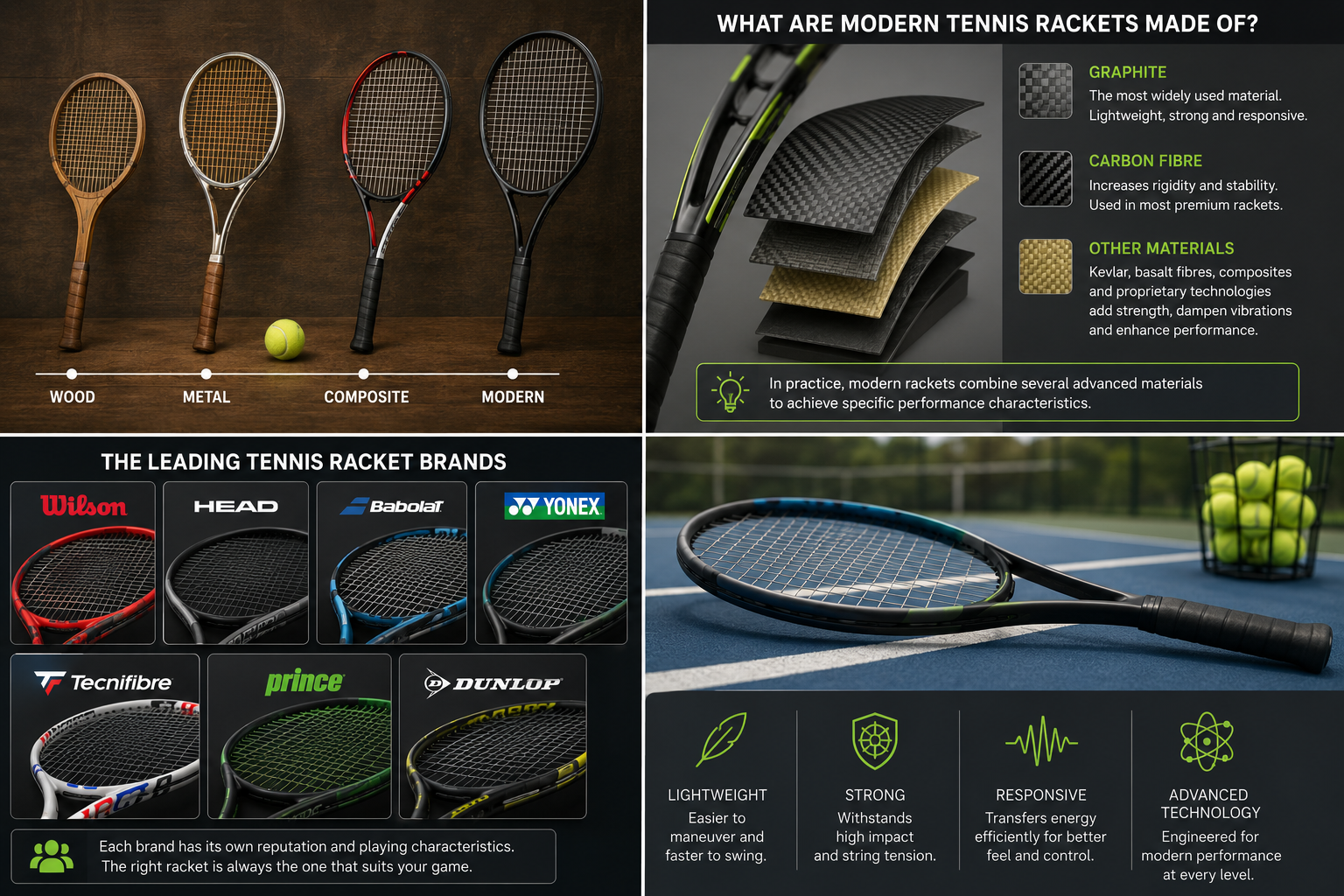
There was a time when every racket was made from wood. Today, wooden rackets are mostly found in museums, private collections and the hands of passionate enthusiasts.
Interesting Fact
Legends such as Rod Laver and Björn Borg began their careers using wooden rackets that were significantly heavier than today's graphite models.
Graphite
Graphite is now the most widely used material in modern tennis rackets.
It offers an excellent combination of strength, light weight and responsiveness, making it suitable for players of all levels.
Carbon Fibre
Carbon fibre is often combined with graphite to increase rigidity and stability. Most premium rackets on today's market rely heavily on carbon-based construction.
Other Materials
Manufacturers may also incorporate:
- Kevlar;
- basalt fibres;
- composite materials;
- proprietary reinforcement technologies.
In practice, most modern performance rackets are built from graphite composites reinforced with carbon fibre and other materials, making the distinction less significant than marketing terms may suggest. In practice, modern rackets typically combine several advanced materials to achieve specific performance characteristics.
The Leading Tennis Racket Brands
Several manufacturers consistently stand out at the top of the tennis market:
- Wilson
- Head
- Babolat
- Yonex
- Tecnifibre
- Prince
- Dunlop
What's interesting is that each brand has developed its own reputation and playing characteristics over the years.
For example, many players associate Babolat with spin-friendly racket designs, while Head is often praised for its versatile all-round performance. Wilson remains a popular choice at every level of the game, while Yonex is known for its distinctive head shape and exceptional feel.
That said, no brand is universally better than another. The right racket is always the one that suits your game, not simply the one with the biggest name.
Racket Cover, Tennis Bag or Backpack?
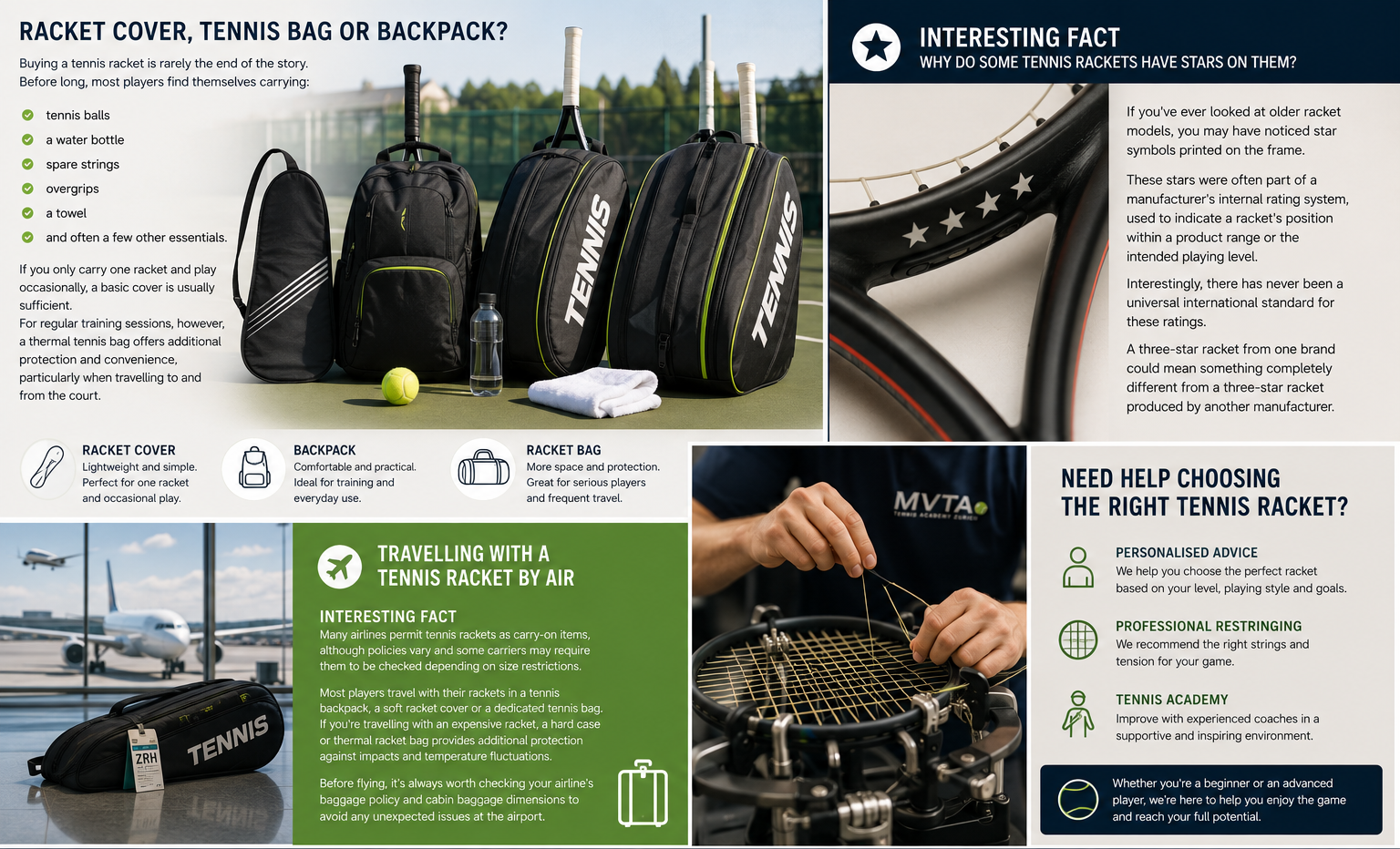
Buying a tennis racket is rarely the end of the story.
Before long, most players find themselves carrying:
- tennis balls;
- a water bottle;
- spare strings;
- overgrips;
- a towel;
- and often a few other essentials.
As a result, many players eventually upgrade from a simple racket cover to a dedicated tennis backpack or racket bag.
If you only carry one racket and play occasionally, a basic cover is usually sufficient.
For regular training sessions, however, a thermal tennis bag offers additional protection and convenience, particularly when travelling to and from the court.
Interesting Fact: Why Do Some Tennis Rackets Have Stars on Them?
If you've ever looked at older racket models, you may have noticed star symbols printed on the frame.
These stars were often part of a manufacturer's internal rating system, used to indicate a racket's position within a product range or the intended playing level.
Interestingly, there has never been a universal international standard for these ratings.
A three-star racket from one brand could mean something completely different from a three-star racket produced by another manufacturer.
Travelling with a Tennis Racket by Air
Interesting Fact
Many airlines permit tennis rackets as carry-on items, although policies vary and some carriers may require them to be checked depending on size restrictions. Most players travel with their rackets in a tennis backpack, a soft racket cover or a dedicated tennis bag. If you're travelling with an expensive racket, a hard case or thermal racket bag provides additional protection against impacts and temperature fluctuations.
Before flying, it's always worth checking your airline's baggage policy and cabin baggage dimensions to avoid any unexpected issues at the airport.
Need Help Choosing the Right Tennis Racket?
Even after reading a detailed guide, selecting the right racket isn't always straightforward.
Specifications on paper tell only part of the story. Once you're on court, two rackets with seemingly similar characteristics can feel completely different from one another.
At MVTA, we help players find the right racket based on their experience level, physical attributes, playing style and personal goals. We'll guide you through key factors such as weight, head size, balance and grip size, and help you identify the strings that best suit your game.
We also offer professional racket restringing services. If your strings have lost tension, feel too stiff or simply need replacing, our team can recommend the most suitable setup and adjust the string tension to match your preferences.
And, of course, we'd be delighted to welcome you onto the court.
At our Tennis Academy, we're passionate about helping players improve while enjoying the game. Whether you're picking up a racket for the first time or looking to take your tennis to the next level, our experienced coaches will help you build confidence, refine your technique and achieve your goals.
We believe that every player is unique. That's why we focus on personalised coaching, a supportive training environment and a professional approach tailored to each individual.
If you have any questions about tennis rackets, strings, equipment or lessons in Zurich, feel free to contact us.
We look forward to seeing you on court at MVTA Tennis Academy Zurich.